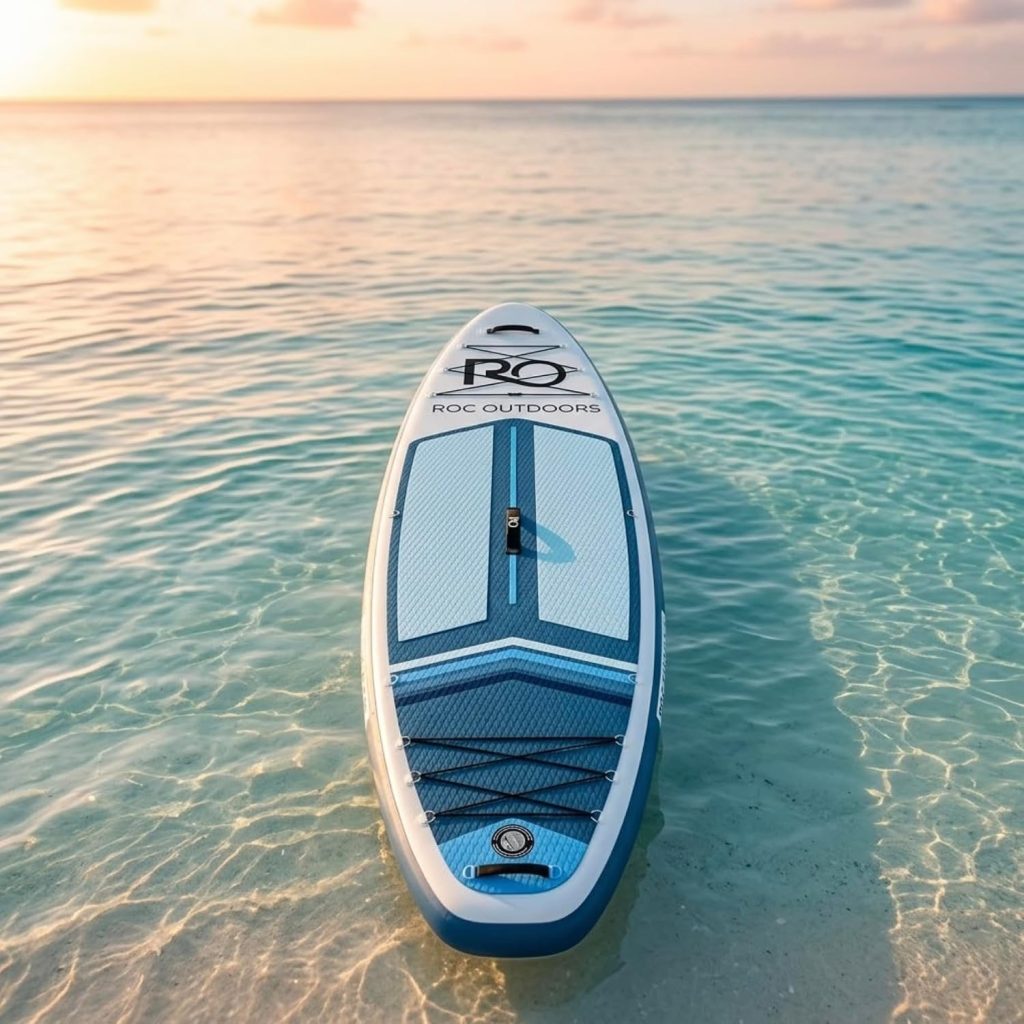
No inflatable paddle board on Amazon has a bigger review pile than the Roc 10 foot 6 inflatable SUP: more than 18,000 ratings averaging 4.8 stars, at a price that hovers around $200 with a full accessory kit. We have warned readers before about the hidden costs of bargain-bin inflatables, so the obvious question is whether the Roc is the exception or just another cheap board with good marketing. We went through the spec sheet, the construction details, and thousands of owner reports to answer it properly.
Roc Inflatable Stand Up Paddle Board 10’6″
The numbers:
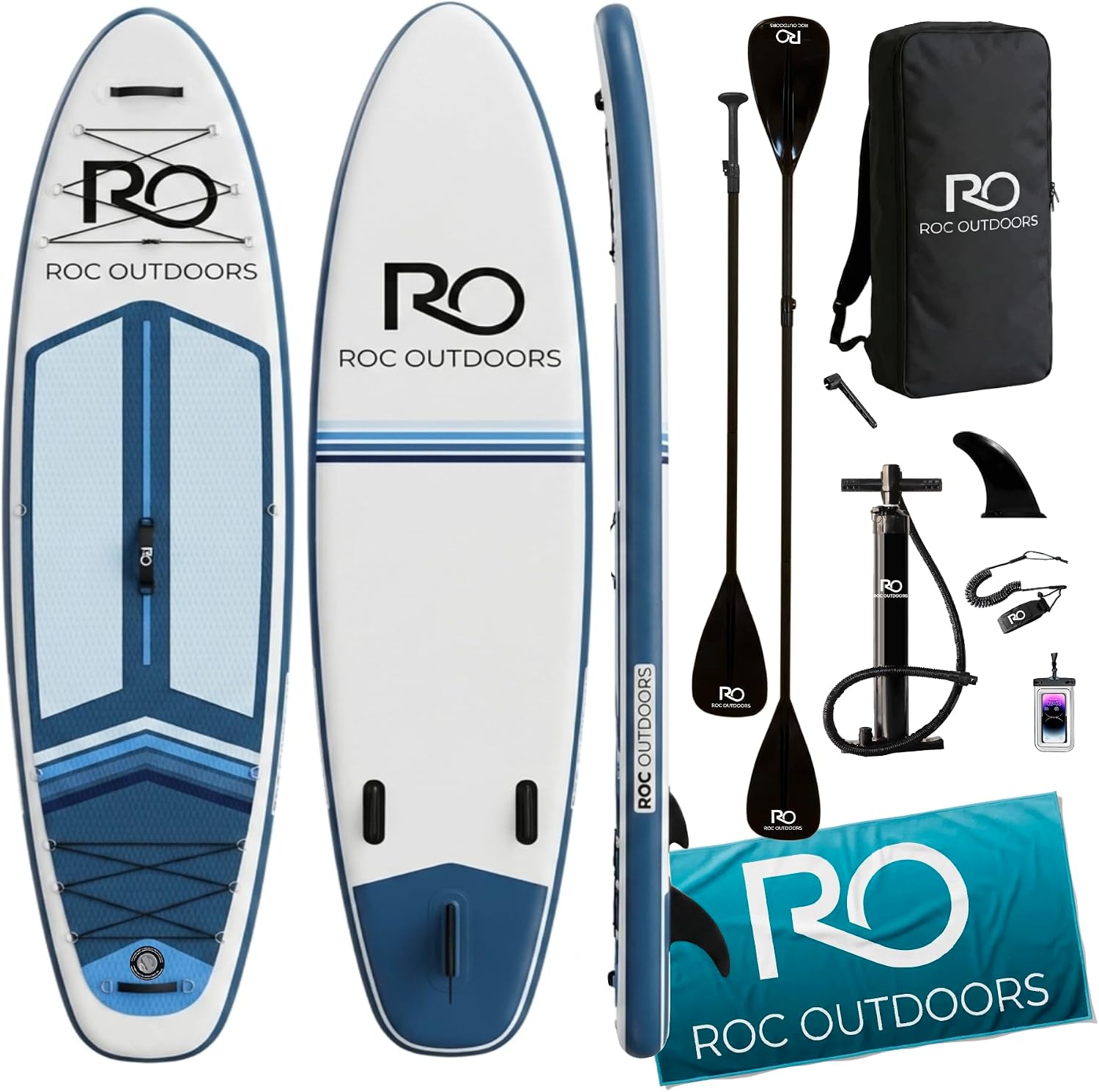
- 10 feet 6 inches long, 33 inches wide, 6 inches thick
- Rated weight capacity: 350 pounds
- Drop-stitch core with PVC laminate, recommended inflation 12 to 15 PSI
- Tri-fin setup: one large removable center fin, two fixed side fins
- Kit includes: 3-piece adjustable paddle, dual-action hand pump, coiled leash, backpack, waterproof phone pouch, valve wrench, repair kit
- 18,000 plus Amazon ratings, 4.8 star average, typically priced around $199 to $219
What 18,000 Ratings Actually Say
Read enough of the Roc’s review pool and a clear picture forms. First-time paddlers love it: the phrase “more stable than I expected” appears constantly, and families report kids, dogs, and nervous beginners all standing up within the first outing. Stability is the board’s genuine strength, and at 33 inches wide it should be.
The praise also extends to longevity, which is where cheap boards usually fall apart. Plenty of owners report two, three, even four seasons of regular use without seam failures or valve leaks. That does not match the throwaway reputation of most sub-$250 inflatables, and it suggests Roc’s quality control is better than the price implies.
The complaints are predictable but worth knowing. The hand pump is the most common gripe: owners say the last few PSI are a genuine workout, and many end up buying an electric SUP pump within a month. A minority of reviews mention slow leaks at the valve (fixable with the included wrench in most cases), and taller or heavier paddlers over about 200 pounds report noticeable flex in the middle of the board when loaded with gear.
On the Water: Stability First, Speed Last
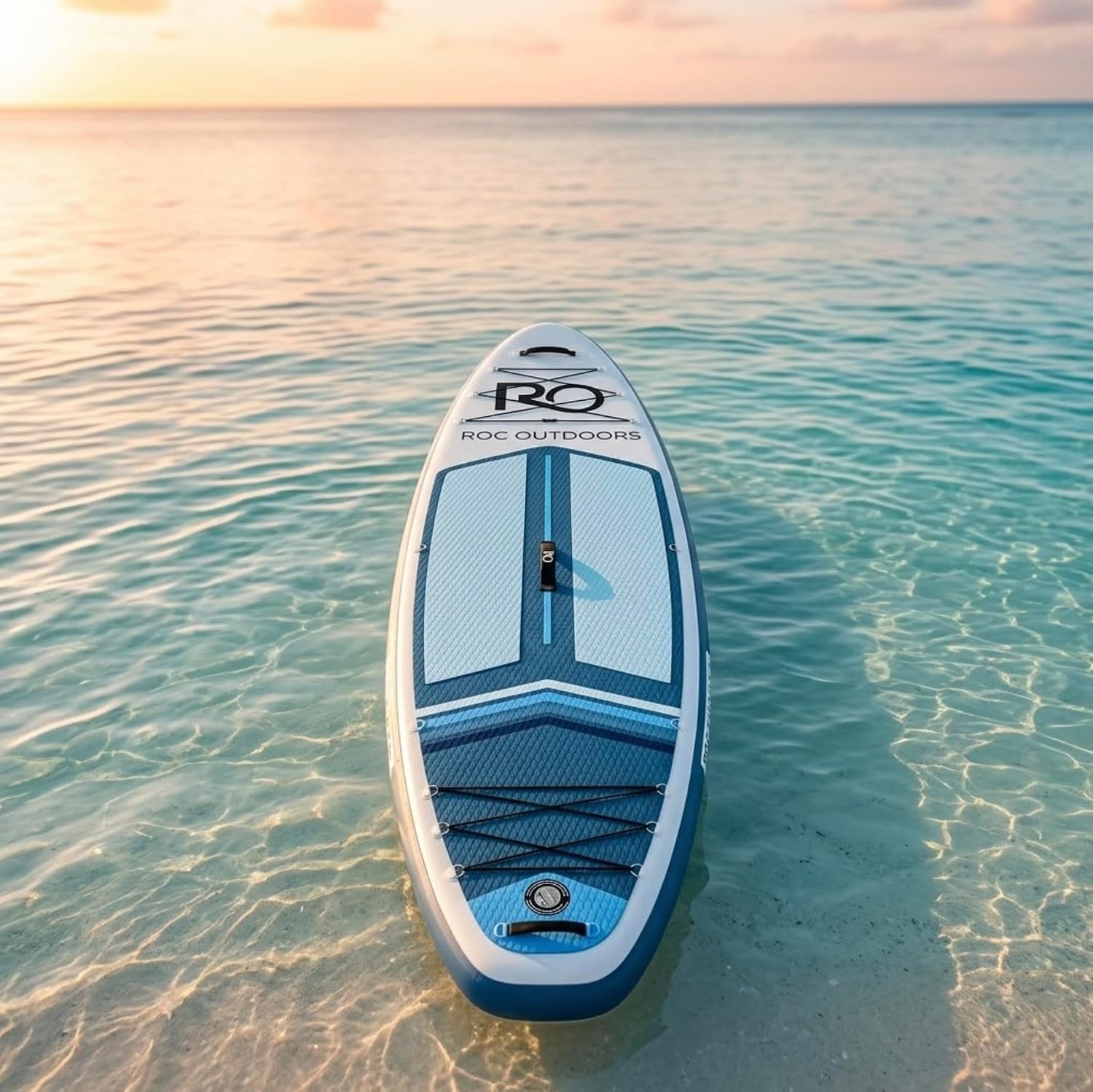
Owners describe the Roc as a calm-water board, and the shape explains why. The wide, rounded outline and tri-fin setup prioritize straight-line stability over glide. For lakes, slow rivers, and sheltered bays, reviewers say it tracks well enough and forgives sloppy technique, which is exactly what a first board should do. The EVA deck pad gets consistent praise for grip, even when wet.
Where it struggles, per owners: chop, boat wake, and any kind of distance paddling. The rounded nose pushes water rather than slicing it, so cruising speed is modest, and lighter paddlers say wind pushes the board around more than narrower touring shapes. If your plan is fitness paddling or covering miles, this is not the hull for it. If your plan is relaxed weekend paddling with the family, it fits the brief.
Construction: Better Than the Price, Not Magic
Here is where we keep our promise to be straight with you. The Roc uses a drop-stitch core with PVC layers, and Roc advertises a reinforced construction with a UV-resistant outer coating. Owner evidence backs up decent durability: seam failures are rare in the review pool, and the board holds pressure well between sessions.
But physics is physics. At this price you get a lighter, simpler laminate than what premium brands use, and that shows up as flex. Paddlers approaching the 350 pound rating, or anyone carrying a kid plus a cooler, report the center of the board sagging slightly, which costs you speed and stability. Inflate it to the full 15 PSI and keep loads moderate, and owners say it firms up fine. This is the honest trade at $200: a board that is genuinely durable and fun for average-weight paddlers, but not one that feels rigid like a $700 board.
The Accessory Bundle: Better Than Expected, With Two Upgrades to Budget
The kit is where Roc beats most budget competitors. Owners rate the backpack as genuinely usable (many cheap bundles include a bag that rips immediately), the leash is padded and comfortable, and the paddle floats and adjusts across a wide range of heights. The included phone pouch and valve wrench are small but welcome.
Two upgrades are worth planning for. First, the paddle: it is a serviceable aluminum-shaft 3-piece, but regular paddlers will notice the weight and flex within a season. When you are ready, moving to a lighter fiberglass or carbon option from the SUP paddle listings makes a bigger difference than most beginners expect. Second, as mentioned, an electric pump removes the one universally hated part of iSUP ownership. Neither upgrade is urgent; both are worth it if you paddle weekly.
One more small note from owners: the single center fin attaches with a hand-tightened pin system that is tool-free and quick, but check it is fully seated before launch. A few reviewers learned that lesson mid-lake.
Who Should Buy the Roc, and Who Should Spend More
Buy it if: you are a first-time paddler, a family buying one board for everyone, or a casual weekend paddler who values stability over speed. At its typical price, the Roc delivers stability, a complete kit, and a durability record that no other sub-$250 board matches at this scale. It is also a reasonable choice for SUP yoga and for paddling with a dog, thanks to the wide deck and grippy pad.
Spend more if: you weigh over 200 pounds and plan to carry gear, you want to paddle distance or in chop, or you already know you love the sport. In those cases, look at premium inflatables in the higher-end iSUP range where stiffer laminates and better shapes earn their price. Our usual advice about ultra-cheap boards stands; the Roc earns its recommendation because its owner-proven durability is the exception, not because cheap boards in general got better.
Frequently Asked Questions
How long does the Roc 10’6″ take to inflate?
Owners report 8 to 12 minutes with the included dual-action hand pump, with the final few PSI being the hard part. Switching the pump to single-action mode for the top end, or using an electric pump, makes setup noticeably easier.
Is the Roc stable enough for complete beginners?
That is its main strength. At 33 inches wide with a rounded outline, the Roc is one of the most stable shapes in its class, and beginners, kids, and dogs all feature heavily in positive owner reviews. Most new paddlers report standing comfortably on their first session.
What is the real weight limit?
Roc rates the board at 350 pounds, and lighter paddlers will never approach that. In practice, owners over about 200 pounds report some mid-board flex, especially with extra cargo. Solo paddlers up to that range do fine; heavy paddlers plus kids or coolers should consider a stiffer, higher-volume board.
Can you use the Roc in the ocean?
Yes, in calm conditions. Owners use it in bays and on mellow beach days regularly. It is not a surf shape, so treat waves as something to avoid rather than ride, and always wear the included leash in moving water.
Does the Roc come with a warranty?
Roc advertises a warranty on its boards, and owners who have contacted the company about valve or seam issues report responsive customer service, which is another area where Roc outperforms anonymous budget brands. Keep your order confirmation and register the board after purchase.
The Roc 10’6″ has earned its review mountain. It is not a premium board at a budget price, because that product does not exist. It is something rarer: a budget board with a proven, multi-season track record and an honest accessory kit. For a first board or a family fleet, it is the safest spend in the category.
