
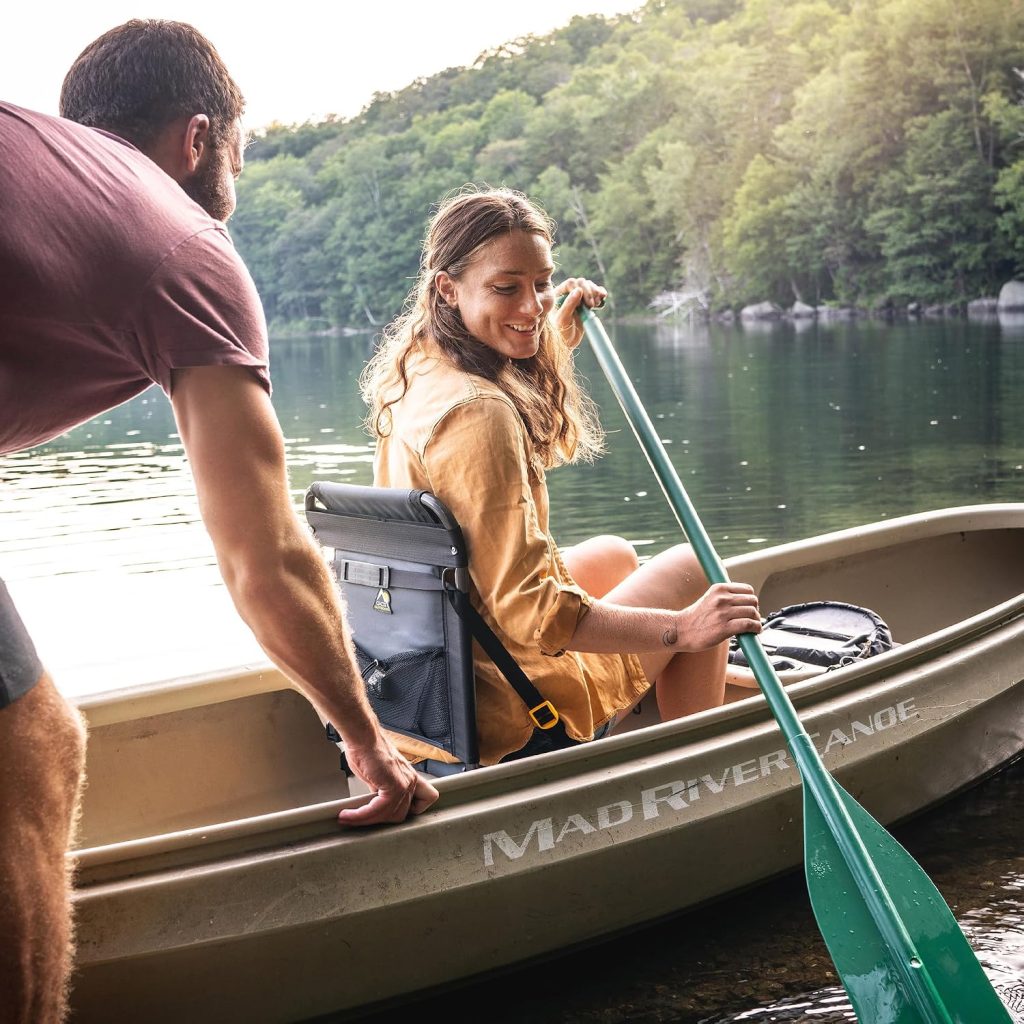
An hour into a canoe trip, the romance of the wooden bench seat wears off. Your lower back starts aching, your legs go numb, and you spend the rest of the day shifting around instead of enjoying the water. That is the exact problem the GCI Outdoor SitBacker was built to solve, and with 3,288 Amazon ratings at 4.5 stars and a price around $50, it has become the most popular canoe seat upgrade on the market. We analyzed the design, the specs, and years of owner feedback so you can decide in five minutes whether it belongs in your canoe. Short answer: for most paddlers, it does. Here is why.
GCI Outdoor SitBacker Adjustable Canoe Seat

What you get:
- Padded seat cushion with an adjustable backrest, built on a collapsible steel frame
- BackAngle adjustment: a strap system that lets you set the recline angle and lock it
- Buckles and straps that clamp to standard canoe bench seats with no tools
- Built-in storage pocket on the back for snacks, sunscreen, or a phone
- Folds flat, weighs about 2.9 pounds, and carries with an attached shoulder strap
- Typical price: $43 to $50 depending on color
Why Canoe Benches Beat Up Your Back in the First Place
A bare canoe bench puts you in the worst possible paddling posture: hips locked at 90 degrees, spine unsupported, every stroke twisting an unprepared lower back. Add a hard surface that concentrates your full body weight on two square inches of tailbone, and you have the recipe for the classic canoeist complaint, a trip cut short by pain rather than weather. Owners who bought the SitBacker describe the same before-and-after story over and over: trips that used to end with an aching back at hour two now comfortably stretch to full days on the water. That transformation, not the fabric or the frame, is what you are actually buying.
What Owners Report After Real Use
Across the 3,200 plus ratings, three themes dominate. First, back support that genuinely works: paddlers with existing back problems, including several self-described seniors and one owner recovering from back surgery, report paddling pain-free for hours with the backrest set upright. Second, stability: the buckle system grips standard bench seats tightly, and owners say the seat stays put even when leaning hard into turns. Third, versatility: a surprising number of owners use it off the water too, on bleachers, at picnics, and around campfires, which softens the $50 spend.
The success pictures are specific. One common report: Boundary Waters style trips where paddling days run 6 to 8 hours, completed without the back pain that ended previous trips early. Another: fishing from the front seat of a tandem canoe all afternoon without once thinking about the seat, which is the highest compliment a comfort product can earn.
Fit, Setup, and Portability

Setup takes under a minute: set the seat on the bench, wrap the straps around it, click the buckles, pull tight, and adjust the backrest angle with the BackAngle strap. No drilling, no hardware, no permanent changes to a rental or borrowed canoe. Owners confirm it fits the contoured bench seats on common rental canoes (Old Town, Mad River, and similar) as well as flat aluminum and wooden benches.
At 2.9 pounds folded flat, it disappears into a portage pack or straps to the outside with the built-in shoulder strap. Several owners mention portaging with it attached to their pack without noticing the weight, and one reviewer called it the best pound-for-pound comfort upgrade in their entire kit.
Where It Comes Up Short
No product with this many fans escapes honest criticism, and you deserve to hear it before spending $50. The most common complaint: the seat cushion is comfortable but thin, and heavier paddlers (over about 220 pounds) report bottoming out on longer trips. The second: the backrest works by leaning against tensioned straps, so very aggressive forward paddling strokes can feel slightly restricted at the shoulders. A few owners also note the buckles can scratch wooden gunwales if you are careless during setup. Finally, it is sized for benches, not for the molded seats in most kayaks; kayak anglers are better served by the strap-on options in the kayak seat category.
The cost of skipping this upgrade is real but modest: another season of cutting trips short, or of watching your less-hardy paddling partners quietly dread the second hour. At $50, the risk-reward math heavily favors trying it.
How It Compares to the Alternatives
The canoe seat market splits three ways. Clamp-on bench seats like the SitBacker dominate for rental-friendly simplicity. Foam roll-up pads are cheaper but offer zero back support, which is the whole point. And full-frame stadium-style chairs adapt poorly to canoes because they are too wide and too tall. If you want to comparison shop before deciding, browse the canoe seats with back support on Amazon and you will find the SitBacker’s rating count dwarfs everything else in the category. That installed base matters: it means years of real-world testing by paddlers, and a manufacturer that has refined the design over multiple generations.
Frequently Asked Questions
Will the SitBacker fit my canoe?
It fits virtually any canoe with a bench-style seat, including the contoured benches on Old Town, Mad River, and Wenonah canoes, according to owner reports. The straps adjust to benches of different widths and thicknesses. It does not fit molded kayak seats or pedestal-style canoe seats.
Can you use the SitBacker in a kayak?
It is not designed for kayaks. The frame is built to clamp onto a raised bench, so it sits awkwardly in a kayak cockpit. Kayak owners should look at strap-on kayak seats instead, which mount to the kayak’s own pad eyes.
How much weight can it handle?
GCI does not publish a hard weight limit, and owners up to about 250 pounds report using it successfully. Heavier paddlers do note the seat cushion compresses fully on long trips, so adding a thin foam pad under the cushion is a common owner modification.
Does it work for long trips and portaging?
Yes. It folds flat, weighs 2.9 pounds, and has a shoulder strap, so it portages easily. Boundary Waters and multi-day canoe trip owners are some of its most enthusiastic reviewers.
Is it worth it for a rental canoe?
Absolutely, and that is one of its best use cases. The no-tools strap system means you can fit it to a rental bench in a minute and remove it just as fast, turning a hard rental bench into the most comfortable seat on the lake.
Your canoe trips should end because the sun went down, not because your back gave out. The SitBacker’s 3,288 owners have already run the experiment for you, and their verdict is consistent: this $50 seat turns hour-two misery into all-day comfort. Check the current price and pick your color.
